Different naming directions
A first run explores several territories instead of giving you one root word in fifty disguises.
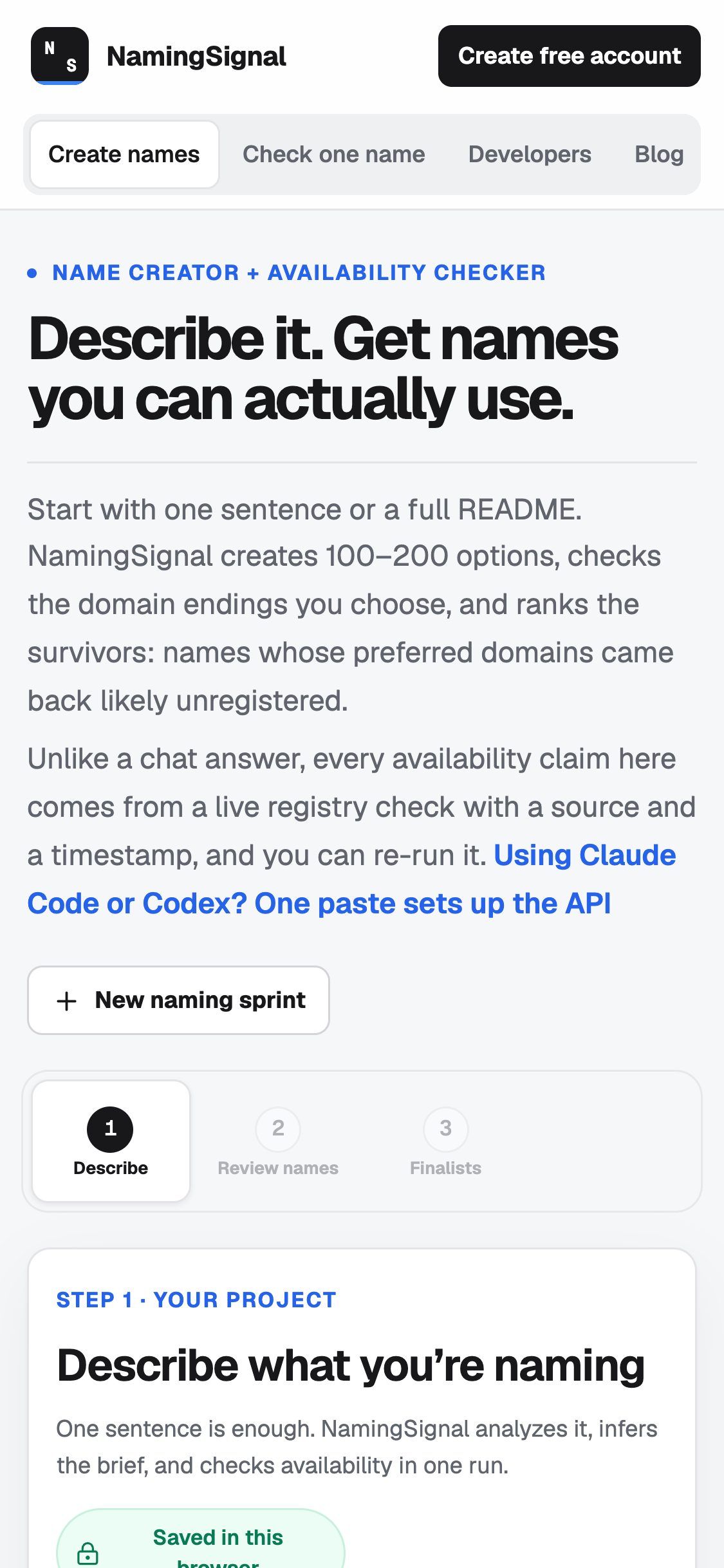
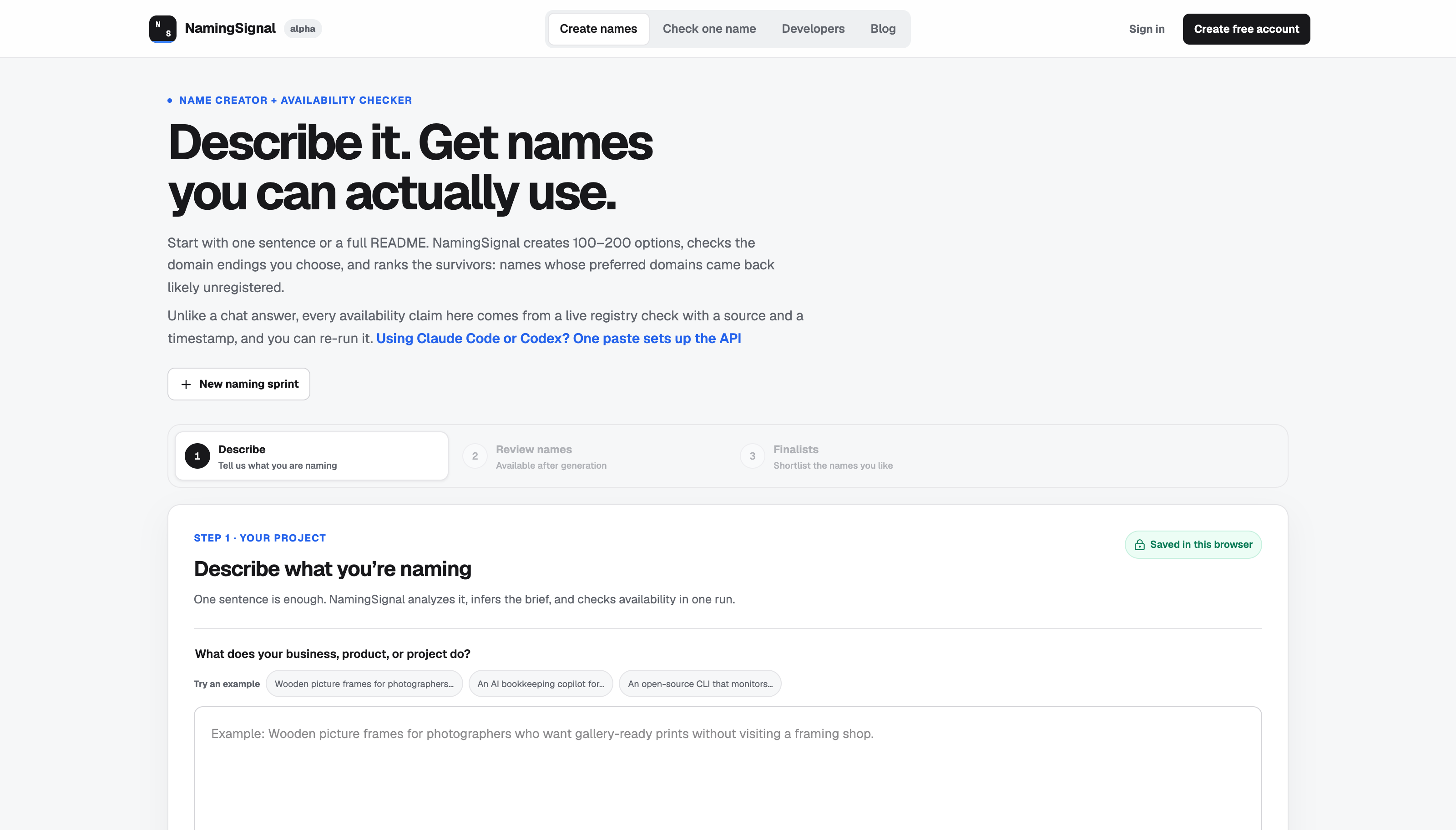
NamingSignal is a product naming tool that turns one sentence or a README into distinct name ideas, checks the domains and developer namespaces you care about, and gives you a shortlist with sources, timestamps, and unknowns kept visible.
Start in the browser, or run the same read-only workflow from Claude Code or Codex through its MCP server.
One sentence, a product brief, or the README already in your repository.
A failed check stays unknown. It never turns into availability.
NamingSignal replaces the usual mix of a chat, registrar tabs, and a stale spreadsheet with one reviewable naming process. It checks what it can, labels what it cannot, and keeps the trail.
A first run explores several territories instead of giving you one root word in fifty disguises.
Domain and namespace claims keep the source and check time beside them. A failed check stays unknown.
The brief, finalists, rejections, evidence, and open manual steps stay together when the chat or tab closes.
The workflow turns context into an editable brief, generates a broad set of candidates, checks the names that matter, and only then spends time researching the final one to three.
Start with one sentence, a README, or a public page. Review the brief before names are generated.
Generate distinct naming directions, then check the domain endings and namespaces you care about.
Research the finalists and keep the sources, check times, rejections, and manual steps in one record.
Availability is not a clean yes or no. NamingSignal uses four states so a timeout or unsupported source never gets presented as good news.
A registry not-found means likely unregistered at the time of the check. It is not a registrar promise, a price, or legal clearance. NamingSignal explains the rule in why domain availability is not a boolean.
The browser is the clearest first run. The MCP server is useful when Claude Code or Codex already has the product context open in your repository.
Describe the project, correct the brief, choose up to five domain endings, shortlist the names, research the finalists, and export the decision.
Open NamingSignal →The remote MCP server lets your coding agent compile the brief, run the checks, research finalists, and return the evidence without leaving the repository.
See the MCP setup →Building your own workflow? Read the REST API documentation. Prefer the terminal? Install @namingsignal/cli.
Claude Code or Codex sends a tool call to the read-only NamingSignal server. The server performs the supported checks and sends the evidence ledger back to the agent. Buying and legal decisions stay outside the loop.
Claude Code or Codex reads the project context you already have open.
Five read-only tools compile, generate, check, research, and return registrar links.
The agent returns the shortlist with sources, timestamps, unknowns, and manual actions.
compile_project_briefTurns project context into an editable brief and names the gaps.
create_naming_sprintGenerates distinct directions, checks selected domains, and returns the survivors first.
check_namesRuns exact domain and optional developer namespace checks.
analyze_candidatesResearches one to three finalists with sources and open questions.
get_purchase_linksReturns registrar search links for the final human check. It never buys anything.
Create a revocable key in the NamingSignal developer console, keep it in an environment variable, then connect the server. The free plan includes 15,000 Naming Credits each UTC calendar month.
claude mcp add --transport http \
  naming-signal https://namingsignal.com/mcp \
--header "Authorization: Bearer YOUR_NAMINGSIGNAL_KEY"# ~/.codex/config.toml
[mcp_servers.naming_signal]
url = "https://namingsignal.com/mcp"
bearer_token_env_var = "NAMING_SIGNAL_API_KEY"
startup_timeout_sec = 20
tool_timeout_sec = 360Use the exact Claude Code quickstart or Codex quickstart for timeout settings and current setup details. The NamingSignal build story shows a real run and explains why unknown must stay unknown.
NamingSignal gets you from a blank page to a short list you can explain. The last mile still needs founder judgment, a current registrar check, and the right legal review.
I built NamingSignal after losing the same afternoon twice to repeated ideas, registrar tabs, and a spreadsheet I did not trust the next morning. The useful output turned out not to be the winning name. It was the record of why the other names lost.
NamingSignal is a product naming tool built by Moe Lueker. It turns a sentence, brief, README, or public page into an editable naming brief, generates distinct name directions, checks selected domains and developer namespaces, and keeps the evidence behind the shortlist.
A typical name generator stops at a list of words. NamingSignal runs a workflow: review the brief, explore several directions, check what can be checked, research the finalists, and keep the sources, timestamps, rejected names, and open manual steps in one record.
It calls registry sources and records the result, source, time, and evidence state. A registry not-found can support likely unregistered at check time, but it is not a promise that the domain is purchasable or available at a normal price. A failed or unsupported check stays unknown.
Yes. Its remote MCP server at namingsignal.com/mcp exposes five read-only tools for compiling a brief, running a naming sprint, checking names, researching finalists, and returning registrar links. Hosted calls use a user-owned API key that you can revoke.
Yes. The live free plan includes 15,000 Naming Credits per UTC calendar month with browser, REST API, CLI, and MCP access. No card is required. The public health route publishes the current allowance and credit schedule.
No. NamingSignal is read-only. It does not buy, reserve, contact owners, file a trademark, or claim legal clearance. It returns registrar links, preliminary research, and the manual actions still open.
NamingSignal is built by Moe Lueker and operated by Zena Labs LLC, the same company behind moelueker.com. The MCP and CLI clients are open source on GitHub.
The free plan includes the browser app, REST API, CLI, and remote MCP server. No card is required.
NamingSignal is built by Moe Lueker and operated by Zena Labs LLC, the same company behind this site. It is in alpha. The free plan is live, while paid plans shown on NamingSignal are still planned and do not have a checkout.