AI Escape Room Test: Gemini 4 Neon vs Opus 5.5 vs GPT-6.2
Five AI models built 3D escape rooms from the same prompt, then an AI team built a sixth. I played all six blind. Gemini 4 Neon beat Opus 5.5 and GPT-6.2.
 By Moe Lueker
I gave five AI models the same prompt: build a playable first-person 3D escape room. Then I had Claude Code and Codex build a sixth one together as a team. I played all six blind, scored them, ranked them, and only then looked at who built which room and what it cost.
The cheapest room cost 96 cents in API-equivalent tokens. The best one cost $211.79. And the best single model wasn't Claude or GPT. It was Gemini 4 Neon.
The short answer: the AI team build ranked first, Gemini 4 Neon second, Claude Opus 5.5 third, GPT-6.2 Astra fourth, Claude Fable 5.2 fifth and GPT-6.2 Sol sixth. If you want the most game for your money, GPT-6.2 Astra on high built a solid room for $3.51 API-equivalent. If you want the best room from one model, Gemini 4 Neon got there, but it was the slowest and priciest single build. You can play all six rooms free in your browser on a computer and judge for yourself.
The results#
| Room (play it) | Built by | Build time | Est. API cost | Blind score |
|---|---|---|---|---|
| 1. D: Venice glass workshop | AI team: Opus 5.5, Astra, Sol | 17.5 h agent time | $211.79 | 9 |
| 2. F: clockmaker's tower | Gemini 4 Neon | 56.8 min | $19.04 | 9 |
| 3. A: stormy observatory | Claude Opus 5.5 | 41.0 min | $12.52 | 5 |
| 4. E: Egyptian temple | GPT-6.2 Astra | 25.4 min | $3.51 | 7 |
| 5. C: professor's study | Claude Fable 5.2 | 20.4 min | $14.89 | 8 |
| 6. B: underwater station | GPT-6.2 Sol | 24.3 min | $0.96 | 6 |
Costs are API-equivalent at each company's list prices, from each run's token logs. Every build actually ran on a subscription, so nobody paid these amounts. The team build's time is agent time summed across sessions (6.4 hours elapsed with at least one agent working). Effort levels: Opus 5.5 and Astra on high, Sol on extra high, Fable 5.2 on medium, Neon not recorded. The rooms need a computer with a mouse and keyboard; they don't run on phones.
The scores were my first impressions, given at the end of a couple of minutes in each room. The ranking came after I had seen all six side by side, so the two don't line up perfectly. Room A got a 5 in the moment and still ended up third. Room C got an 8 and ended up fifth. If you want to see the reveal the way I saw it, the reveal board on my site lets you rank the rooms yourself before you flip the cards.
How the test worked#
- Same prompt, separate folders. Every model got the identical prompt in its own empty folder, with no access to the others' work.
- Each model in its strongest coding agent. Claude Code for Opus 5.5 and Fable 5.2, Codex for GPT-6.2 Astra and Sol, and Antigravity for Gemini 4 Neon.
- Effort levels I actually use. Opus 5.5 and Astra on high, Sol on extra high, Fable 5.2 on medium. Gemini 4 Neon ran as an agent team in Antigravity (a swarm of eight worker agents), and its effort level wasn't recorded.
- Blind play. The rooms were shuffled and labeled A to F. I played and scored each one before I knew who made it.
- Costs are estimates, not bills. Each cost is API-equivalent at the company's list prices, calculated from that run's token logs. Every build actually ran on my subscriptions.
That makes the effort levels uneven. Fable 5.2 ran one step below Opus and Astra, and Neon had a team of agents behind it. I picked those settings because that's how I work with these models day to day, not to make it a perfectly level benchmark.
Every room is a static website, so once they were built I put them online with the Hostinger MCP straight from Claude Code. Hostinger sponsored the video, which I'm thankful for, and I've used them for over a year to host my Hermes agent, my DeepSeek harness and a few of my websites. I show the exact prompt further down.
Room by room, best to worst#
1. Room D: the Venice glass workshop (AI team)#
This one was a different league from the first screen. It had an animated entry screen, a 20-minute timer like a real escape room, a journal that fills up with clues, an inventory, several rooms and an upstairs. You could jump. One puzzle has you hold a red glass up to a slate to read a hidden code, which is the moment I said "that is so cool" out loud.
My one complaint: when you pick something up, it floats in front of a blank screen instead of showing up in your hand. I gave it a 9 and ranked it first.
The team build was not one prompt, and that matters for the result. Claude Opus 5.5 planned the game, coordinated the work and polished the UI in Claude Code. GPT-6.2 Astra and Sol did most of the building in Codex. Between rounds there were plan reviews, code reviews and my own playtests. So the team was three models, Opus, Astra and Sol, with a human in the loop. It took about 17.5 hours of agent time summed across sessions (6.4 hours elapsed with at least one agent working) and roughly 508 million tokens.
2. Room F: the clockmaker's tower (Gemini 4 Neon)#
The level of detail stood out right away: a star map, mirrors that catch the light, a secret bookshelf and an inventory bar at the bottom. The best moment is a crystal prism that sends a beam of light across the room, which you then steer with mirrors. I was hooked. I said eight or nine on camera and put a 9 on the board.
The catch is speed. Neon took 56.8 minutes, the longest of any single build, and cost $19.04 API-equivalent. Still, getting this quality for about a tenth of the team build's cost is the most surprising result in the test. I go deeper on what Neon costs at each thinking level in my Gemini 4 Neon pricing and benchmarks breakdown.
Play the Clocktower Sanctum room
3. Room A: the stormy observatory (Claude Opus 5.5)#
Lightning, rain on the windows, a telescope, a spinning globe and an orrery. The first puzzle is clean: a note tells you the drawer opens at the time the clock stopped, you read the clock, and the drawer pops open with a key and the next clue.
In the moment it felt a bit basic. The fire is just a light. I gave it a 5. But when I lined all six up, I ranked it third. It took 41.0 minutes and $12.52.
Play the Vesper Observatory room
4. Room E: the Egyptian temple (GPT-6.2 Astra)#
The 3D columns and walls here almost look the best of all six. The puzzles are word riddles about the sun's path, which I liked, and I couldn't crack them in my first two minutes.
What held it back was the interface. A big title badge sits in the top left the whole time, you have to click a small marker instead of the object itself, and those markers make it too obvious where the clues are. It feels like one or two more prompts away from a great room. I gave it a 7.
Then the reveal: Astra built it in 25.4 minutes for $3.51. That's about a fifth of Neon's cost and under a third of Opus's, in less than half of Neon's time. In September I ran the older GPT-6 Astra against Opus 5.5 on two game prompts, and Opus built the better game both times. Opus still finished ahead here, but the price gap is the story now.
5. Room C: the professor's study (Claude Fable 5.2)#
Room C looked a lot like Room A: an observatory study with an orrery, a clock, a telescope and a globe. Both turned out to be Claude builds from the same prompt, so my guess is the two models simply read it the same way. Room C had more detail, a calm crackling fire and a nice flow through its first three puzzles. One of them, pressing four marked books in the order of a day, was a bit obvious, but I never asked for hard puzzles.
I said seven or eight on camera, put an 8 on the board, then ranked it fifth once I'd seen the full field. Fable 5.2 was the fastest build at 20.4 minutes, but at $14.89 it cost more than Opus. I'm honestly surprised I didn't like it more. It ran on medium, one step below Opus, so I want to try it again on a higher effort level. If you're deciding between the two Claude models, my Fable 5.2 vs Opus 5.5 comparison covers cost per task at every effort level.
Play the Hollowmere Study room
6. Room B: the underwater station (GPT-6.2 Sol)#
A low hum, ballast tanks, a signal decoder where you enter beacon symbols in the right order, and a power panel to rewire. I liked the overall design, but the graphics and detail weren't quite there, the key looked glitchy, and the puzzles were simpler than the rest. I gave it a 6 and ranked it last.
It also cost 96 cents. That's the cheapest room by far, built in 24.3 minutes. For a game nobody had to touch by hand, that's still a playable result.
What the costs tell you#
The team build cost about 11 times Gemini 4 Neon's room and about 220 times GPT-6.2 Sol's. It used around 508 million tokens. Neon used 29.9 million, Opus 26.8 million and Fable 17.1 million, while Astra and Sol each got by on under 3 million.
The team build was the best room, and I'm not surprised. Claude Code and Codex review each other's plans and code, so they catch each other's weak spots. But it doesn't justify a cost that's at least 11 times what any single model cost, at least not for a game like this.
On paper these models score close together. Give them a real game to build, one that needs taste, logic and working 3D at the same time, and the gaps show up fast. The full launch numbers for the OpenAI pair are in my GPT-6.2 Astra and Sol price and benchmark guide.
Which AI model should you use to build a game?#
Here's where I landed after playing all six:
- For your everyday build partner: Claude Opus 5.5. I've always liked building with Opus. It gets what I mean and it's easy to work with, so I'm sticking with it.
- For the best price: GPT-6.2 Astra. A $3.51 room that ranked fourth gives me confidence that, steered well, Astra handles most simple builds at a fraction of the cost.
- For the best single-model result: Gemini 4 Neon. It's slow, but it built the second-best room for $19.04 API-equivalent, and it ran on my Gemini subscription. It's an absolute beast.
- If quality matters more than cost: a team. Opus planning with Astra and Sol building, plus reviews and real playtests, made the best room. For me it didn't justify the price, so budget for it, in tokens and in hours.
- If cost is everything: GPT-6.2 Sol. 96 cents bought a playable room, but it was the weakest of the six.
Whichever model you pick, steering matters. Astra's room felt one or two follow-up prompts away from great, and the team build won partly because it got reviews and playtests between rounds.
Detailed follow-up prompts are faster to say than to type. Rambleproof, the Mac dictation app I built, lets you say them instead: press Right Option, describe what to fix, press it again, and clean text lands at your cursor in Claude Code, Codex or your editor.
How I put the rooms online with the Hostinger MCP#
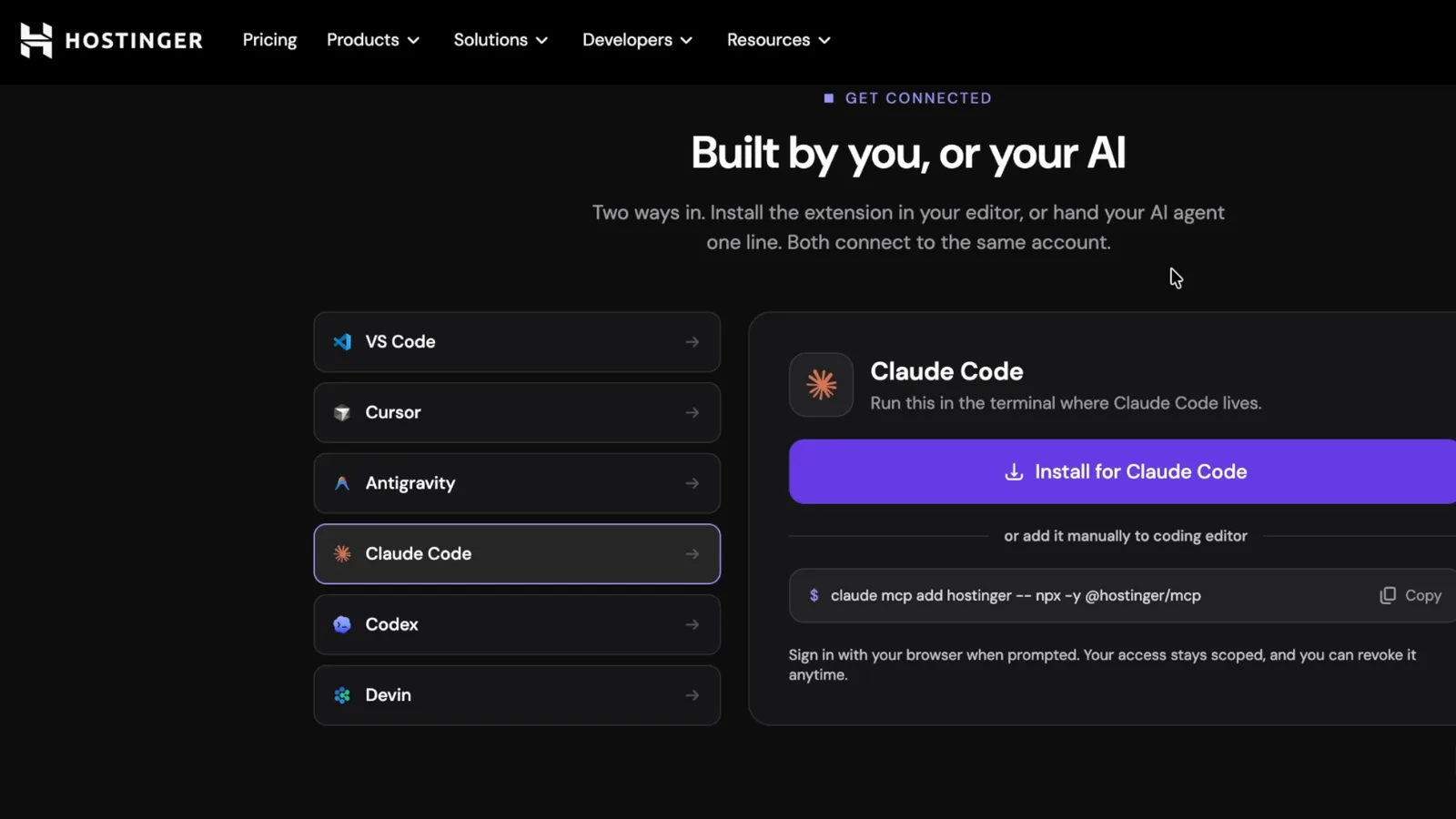
A game sitting in a folder on your laptop isn't much use to anyone else. Hostinger has its own MCP, so pretty much any coding agent can publish to your hosting account. You can add it to Claude Code with one click from Hostinger's page, paste the install command into your terminal, or search for Hostinger Connector in your plugins.
Then, inside the folder with the finished game, I sent this:
The folder you're currently in is a finished website. I want you to use the hosting MCP to publish it on my Hostinger account. Let me know if you have any questions.
Claude asked me two questions: publish to a new website or an existing one, and publish the files as they are. In under five minutes the rooms were live on a new Hostinger site. From there you can ask Claude to find an available domain, or to publish to a domain you already own. If you want the full setup walkthrough, I wrote up what the Hostinger Connector is and how to use it.
If you don't have a hosting plan yet, get one through my Hostinger link and use code MOELUEKER at checkout for an extra 10% off.
FAQ#
Which AI built the best escape room?
In my blind test the AI team build won: Claude Opus 5.5 planning and polishing the UI in Claude Code, with GPT-6.2 Astra and Sol doing most of the building in Codex. Of the single models, Gemini 4 Neon built the best room, followed by Claude Opus 5.5, GPT-6.2 Astra, Claude Fable 5.2 and GPT-6.2 Sol.
Is Gemini 4 Neon better than Claude Opus 5.5 for building games?
In this one test, yes. Gemini 4 Neon's clocktower room ranked second overall and first among single models, ahead of Opus 5.5 in third. It was also the slowest and most expensive single build: 56.8 minutes and $19.04 API-equivalent, against 41.0 minutes and $12.52 for Opus 5.5 on high. Neon ran as an agent team in Antigravity, so it isn't a pure one-model comparison.
Which model gives the best value for building a game with AI?
GPT-6.2 Astra on high. It built the fourth-ranked room in 25.4 minutes for $3.51 API-equivalent, about a fifth of Gemini 4 Neon's cost and under a third of Opus 5.5's. GPT-6.2 Sol was cheaper at $0.96 but built the weakest room.
How much did the AI team build cost?
$211.79 API-equivalent for roughly 17.5 hours of agent time summed across sessions, and about 508 million tokens. That is around 11 times Gemini 4 Neon's single build and about 220 times GPT-6.2 Sol's. It ran on subscriptions, so nobody paid that bill. The figure leaves out Codex's own auto-review sessions and may understate Opus.
Were all the escape rooms built from one prompt?
The five single-model rooms were. Each model got the same prompt in its own empty folder, with no access to the others. The team build was not one prompt: it went through plan reviews, code reviews and my playtests between rounds.
Can I play the AI escape rooms?
Yes. All six run free in your browser at moelueker.com/games/escape-room, on a computer with a mouse and keyboard. The rooms there are ranked best first and don't show which model built them until you open the reveal page.
Watch the full test, including the solution for every room, on YouTube: https://youtu.be/BU8RyeEj11Q
Some links above are affiliate links, so I may earn a commission at no extra cost to you. I only recommend tools I actually use.
Moe shares tool walkthroughs and lessons from real projects. Mechanical engineer, then venture capital, now building AI tools for creators and small businesses. More about Moe
Get new videos in your inbox
Weekly AI workflows. No fluff.
No spam. Unsubscribe anytime.