Claude Fable 5.2 vs Opus 5.5: Price, Best Effort Level, and What It's Good At
Claude Fable 5.2 costs $8/$40 per million tokens, twice Opus 5.5. The cost per task at every effort level, what early users report, whether it is good at design, and when to use it.
 By Moe Lueker
Anthropic released Claude Fable 5.2 today, November 9, 2026. It costs $8 per million input tokens and $40 per million output tokens. That is 20% cheaper than Fable 5.1 and exactly twice the price of Claude Opus 5.5.
So the real question is not "is it smarter?" It is. The question is when it is worth paying double, and which effort level to run it on so you don't pay four times as much for the same answer. I read the 264-page system card, pulled the cost-per-task data out of Anthropic's launch charts, and went through the first reviews and the Hacker News thread from people who have used it. Here is what I found.
If you only have a minute#
What does it cost? $8 in and $40 out per million tokens on the API. Cache reads are $0.20 per million. Batch is half price. Fast mode is $16 and $80.
Is it better than Opus 5.5? On most benchmarks, yes. It scored highest on 14 of the 16 results in Anthropic's summary table. Opus 5.5 still wins on judged office documents and slides, and on long-context coding.
Which effort level? High for hard work. On Anthropic's coding benchmark, Fable 5.2 on high matched Opus 5.5's best score for about half the cost per task. Use xhigh only for your hardest long jobs, and skip max.
The catch: on easy tasks it just costs more. One independent test had Fable 5.2 on high cost $7.70 a task where Opus 5.5 on high cost $1.70, and both passed every test.
Is it good at design? At turning a mockup or screenshot into working code, yes, clearly. At taste on its own, not reliably. More on that below.
Should you switch? Keep Opus 5.5 as your daily model. That is also Anthropic's own advice. Move up to Fable 5.2 for long agent runs, big codebases, hard research and anything Opus keeps getting wrong.
Claude Fable 5.2 price vs Opus 5.5#
All prices are per million tokens, from the Claude Platform pricing page and the Fable 5.2 model page, checked November 9, 2026.
| Token type | Fable 5.2 | Opus 5.5 | Fable 5.1 |
|---|---|---|---|
| Input | $8 | $4 | $10 |
| Output | $40 | $20 | $50 |
| Cache write (5 min) | $10 | $5 | $12.50 |
| Cache write (1 hour) | $16 | $8 | $20 |
| Cache read | $0.20 | $0.20 | $0.25 |
| Batch input / output | $4 / $20 | $2 / $10 | $5 / $25 |
| Fast mode input / output | $16 / $80 | not compared | not compared |
Two details matter more than the sticker price.
Cache reads cost the same as Opus. Fable 5.2 charges 2.5% of its input price for a cache hit, which lands at the same $0.20 as Opus 5.5. Agents reread the same context over and over, so on long sessions the input side of the gap shrinks. The output side does not.
Output is where the bill comes from. Fable 5.2 thinks before almost every reply at high effort and above. The what's new page says a prompt line like "answer directly" no longer stops it. Those thinking tokens are billed as output at $40 per million. The only real control is the effort setting.
On a subscription: Claude Code and the Claude apps have it now. During launch week, Anthropic says eligible paid plans get one to three extra Fable usage resets depending on how long you have subscribed, and Fable can use up to half of the weekly limit on Pro and standard Team seats (announcement).
What it costs per task, at every effort level#
Price per token tells you little. What you pay is price times tokens, and Fable 5.2 can spend a lot of tokens. Anthropic charts score against cost per task for every effort level, but does not print most of the numbers. They are in the launch page's source, so I pulled them out. Pick a benchmark and an effort level:
Hover or tap any dot for its score and cost. Each dot is one effort setting, from low on the left to max on the right. Up and to the left is better: a higher score for less money per task.
Would the maintainers merge the code change?
Fable 5.2 on high: 45.3% for $6.72 a task.
- Opus 5.5 for the same money or less (dashed ring): 43.4% on xhigh ($5.18).
- Opus 5.5 at its best: 45.5% on max ($12.82). This Fable setting scores lower.
Extracted from the chart data embedded in Anthropic’s Fable 5.2 announcement on November 9, 2026. Costs are Anthropic’s own estimates at list prices ($8/$40 per million tokens for Fable 5.2, $4/$20 for Opus 5.5, $10/$50 for Fable 5.1), so treat this as a vendor chart. “Same money” allows 5% over. Tap a model in the legend to show only that model.
The coding numbers, from Cognition's FrontierCode 2.0 run (system card, page 209):
| Fable 5.2 effort | Score | Cost per task |
|---|---|---|
| Low | 34.2% | $2.10 |
| Medium | 37.6% | $2.48 |
| High | 45.3% | $6.72 |
| Xhigh | 49.1% | $14.19 |
| Max | 45.7% | $44.70 |
| Opus 5.5, best (max) | 45.5% | $12.82 |
What stands out:
- High is the value setting for coding. 45.3% for $6.72, against Opus 5.5's best of 45.5% for $12.82.
- Xhigh is the top score of any model tested, 49.1%, for about the same money as Opus on max.
- Max is worse than xhigh and costs three times as much. 22 of its 660 attempts timed out.
- On reasoning and chart reading, low effort is enough. On Humanity's Last Exam with tools, Fable 5.2 on low scores 68.4% for $0.19 a task. Opus 5.5 on max scores 67.7% for $2.18.
- On deep research reports, Opus 5.5 is better value. In the DRACO chart (system card, page 219), Opus 5.5 on medium scores 83.9% for roughly $2 a task, while Fable 5.2 on low scores 81.6% for a bit more. Fable only pulls level at max, for about twice the cost.
The best effort level for Claude Fable 5.2#
Claude Fable 5.2 has five effort levels: low, medium, high, xhigh and max. The API default is high. Claude Code and the Claude apps default to medium.
Here is how I would set it, based on the system card, Anthropic's effort docs and the early user reports:
- Medium for routine coding, quick questions and chart or document reading. It is the Claude Code default for a reason.
- High for real work: multi-file changes, debugging, research, agent tasks that run a while. This is where Fable 5.2 beats Opus 5.5 on value in Anthropic's data.
- Xhigh for the hardest long-running coding jobs, after you have seen high fall short.
- Max almost never. It lost to xhigh on FrontierCode, scored lower than high on ARC-AGI-3 (65.7% against 79.3%), and one Hacker News tester saw it spend the whole 128,000-token output limit on thinking and return nothing.
The system card backs this up in other places. On CursorBench, high scored 56.9% using about 99,000 output tokens per task, and max scored 60.0% using about 353,000 (page 213). On GDPval-AA, xhigh used about 57% fewer output tokens than max (page 239).
One warning in the other direction. Anthropic's docs say low and medium are more likely to end a turn before the work is done, with a list of what is left. If Fable keeps stopping early on a long job, go up a level instead of typing "continue".
Is it worth twice the price? What independent tests show#
Anthropic's "half the cost" claim compares Fable on high with Opus on max. Most people run Opus 5.5 on medium or high. The first independent test I found compared like with like.
Atomic Agent ran both models on one coding task, a 1,400-line Python library with 13 planted bugs and a missing feature, three runs each:
| Model and effort | Hidden tests passed | Time | Cost per task |
|---|---|---|---|
| Opus 5.5, medium | 59/59 | 4.2 min | $0.97 |
| Opus 5.5, high | 59/59 | 9.6 min | $1.70 |
| Fable 5.2, medium | 59/59 | 4.2 min | $1.87 |
| Fable 5.2, high | 59/59 | 26.6 min | $7.70 |
Every run passed. On a task Opus can already do, Fable 5.2 on its default setting cost 4.5 times as much and took almost three times as long. One task is a small sample, and it is a vendor blog, but it matches what people in the Hacker News thread reported. One commenter measured Fable 5.2 on high writing 76,158 tokens for $3.05 where Opus 5.5 wrote 19,767 for $0.40. Another ran 30 everyday coding tasks and found both models solved 26.
So Fable 5.2 is not a better everyday model. It is a better hard-problem model. The gap shows up on long, open-ended work, not on tasks with an obvious answer.
What early users say: pros and cons#
These come from people who used it, not from the launch page. Several had early access from Anthropic, which I note where it applies.
The pros
- It finishes big, long jobs. Ethan Mollick (early access, unmetered) had it build several large projects from short prompts, including a course website and a paper, and found no major errors when he checked. Matt Shumer (early access) wrote that a single agent built a Battle Royale game with essentially no steering.
- It handles huge, strange codebases. A Hacker News commenter who tested it early said it sped up a 600,000-line Fortran codebase for materials science 36 times in two days, where Fable 5.1 was 3 to 4 times slower at the same work.
- It is faster than Fable 5.1. Anthropic says up to 30% faster output. Users in the thread agreed it feels quicker, and one measured 0.62 times the time of Fable 5.1 on the same tasks.
- It adds depth nobody asked for. One tester who vibe-codes small games found the graphics no better, but Fable added gameplay that made sense, like an airship so the player could reach islands.
- It admits what it doesn't know. A Cognition engineer quoted in the launch post said it refused to give a number until it had measured the change.
The cons
- It burns usage fast. One Hacker News user asked for at most four subagents, got six or more nested ones, and drained a full five-hour usage window on a $100 plan in under 20 minutes. Anthropic's own docs warn that subagents can be a large part of a session's cost.
- It is overly cautious. Shumer calls it "a narc": it refused to deploy a product change and its privacy policy update together, and one of his agents emailed an agency 33 times without asking.
- Its taste needs steering. Mollick's first course site was "accurate and joyless," and its first attempt at beautiful was a kids' bell-ringing game. Each fix took minutes, but it did not notice the problems itself.
- It still writes like Claude. Mollick and Shumer both mention the familiar "Claude-speak," and some commenters prefer other models' prose.
- Long context is a weak spot. On ProgramBench, it ran out of its 1 million token window before finishing on 68% of tasks, against 39% for Opus 5.5 (system card, page 216). Showing it how much context was left fixed most of that.
- Cybersecurity work is mostly blocked. Fable 5.2 has strict cyber safeguards and falls back to an older model on flagged requests. Security teams need Mythos 5.2, which requires verification.
Is Claude Fable 5.2 good at design?#
Short answer: it is very good at building a design you already have, and only sometimes good at inventing one.
Where it is strong:
- Screenshot or mockup to code. On SWE-bench Multimodal, coding tasks that include screenshots and design mockups, Fable 5.2 scored 74.1% against 61.4% for Opus 5.5 (system card, page 208). In an image-to-HTML test posted to Hacker News, the tester called Fable's version the most faithful to the source design, with more accurate icons and SVG shapes than Opus 5.5.
- 3D and visual references. Unity told Anthropic it builds better 3D scenes from scratch and is good at rebuilding an experience from a visual reference.
- Drawings to parts. On BenchCAD, which rebuilds parts and circuit boards from engineering drawings, it scored 83.5% against 65.3% for Opus 5.5.
Where it is not:
- Taste without examples. Shumer calls it the first model capable of "insanely good design," but only after you give it lots of examples of what you like. Mollick had to push it twice to get something beautiful. Claire Vo's How I AI episode on Lenny's Newsletter has a chapter titled "Where it falls down: web design."
- Judged documents and slides. On GDPval-AA and AA-Briefcase, where judges compare finished documents, slides and diagrams, Opus 5.5 still scored slightly higher (Elo 1866 against 1831, and 1800 against 1785).
- Warmth and creative writing. Anthropic's own audit scored the underlying model lower than Opus 5.5 on warmth and lower than the last Mythos on creative mastery (system card, page 119).
- Motion. The same image-to-HTML tester found Opus 5.5 better at motion and animation.
My rule: hand Fable 5.2 a Figma export, a screenshot or a reference site and let it build. For open-ended visual exploration, start with Opus 5.5 at half the price, then use Fable to implement the direction you pick.
When to use Fable 5.2, and when to stay on Opus 5.5#
Use Fable 5.2 for:
- Long agent runs that take hours, and big migrations or rewrites
- Large or unfamiliar codebases, performance work and scientific computing
- Wide research that needs facts on dozens of companies or products, with sources
- Building from a visual reference: mockups, screenshots, CAD drawings
- Hard math, physics and reasoning, where even low effort beats Opus on max
- Real freelance-style projects end to end. On the Remote Labor Index it completed 41.3% of real freelance projects at least as well as a human, against 21.3% for Opus 5.5
- As an advisor or orchestrator over cheaper models, which Anthropic suggests directly
Stay on Opus 5.5 for:
- Everyday coding and edits that Opus already gets right
- Deep research reports, where Opus gives more per dollar
- Documents, slides and office deliverables judged on presentation
- Health and medical questions, where Opus 5.5 scored higher on HealthBench and PhysicianBench
- Anything where speed matters more than depth
- Security work, which Fable's safeguards mostly block
If you have not changed models in Claude Code before, here is how to change the model in Claude Code. For the full picture on the cheaper option, read my Claude Opus 5.5 review.
How to get good results from Fable 5.2#
Anthropic's prompting guide for Fable 5.2 and the early reviews point to the same habits:
- Set the effort level yourself. Medium for routine work, high for hard work. Don't rely on prompt lines like "be quick", which it no longer follows.
- Say who owns the code. Without that, it tends to report nearby problems instead of fixing them. "You own the CSS, don't touch the API" changes what it does.
- Say what done looks like. Tell it to keep going until the tests pass or the screenshots match, so it does not stop at a list of what is left.
- Cap subagents and check the bill. It delegates readily in Claude Code, and users have seen it ignore a stated limit. Watch your usage on the first long run.
- Give examples for anything visual. Reference images, a site you like, your brand colors. This is the difference between "joyless" and good.
- Talk the long brief instead of typing it. A good Fable brief is a few paragraphs: the goal, the files, the limits, who owns what, and how to check the result. On a Mac, I speak mine with Rambleproof, the dictation app I built, and clean text lands in Claude Code or wherever my cursor is.
- Don't carry over strict style rules. The docs say it follows style rules very closely, so a hard limit like "every sentence under 12 words" makes its writing choppy.
Where to find the cost and intelligence charts in the system card#
The Fable 5.2 and Mythos 5.2 system card is 264 pages. The comparison charts are all in section 8. Page numbers below are the PDF pages, which match the printed page numbers (the table of contents is one page off for section 8.1).
| Page | What it shows |
|---|---|
| 207 to 208 | Summary table: Fable 5.2 vs Fable 5.1, Opus 5.5 and GPT-6 Astra on 16 results |
| 209 to 210 | FrontierCode 2.0 score and cost per task at every effort level. The best single chart for Fable vs Opus on price and performance |
| 213 to 214 | CursorBench 4.0 score and cost per task by effort |
| 216 | ProgramBench long-context coding, where Opus 5.5 wins |
| 217 to 218 | Humanity's Last Exam, with and without tools, cost by effort |
| 219 | DRACO deep research, where Opus 5.5 is better value |
| 221 | WANDR wide research, cost by effort |
| 230 to 231 | Chartography, including Fable on low matching Opus on max |
| 233 to 234 | BenchCAD, drawings to CAD, cost by effort |
| 236 to 237 | OSWorld computer use, price against score |
| 240 | AutomationBench business workflows, with the list price used for costs |
| 241 to 242 | Real-World Finance and Remote Labor Index |
For the behavior side, page 119 covers character traits like warmth and creative mastery, and pages 83 to 88 cover prompt injection and the fallback to an older model.
Talk to Fable the way you think#
The biggest difference I see between a $2 Fable run and a $40 one is the brief. A vague one-liner sends it exploring, delegating and thinking on your dime. A clear paragraph tells it where to stop.
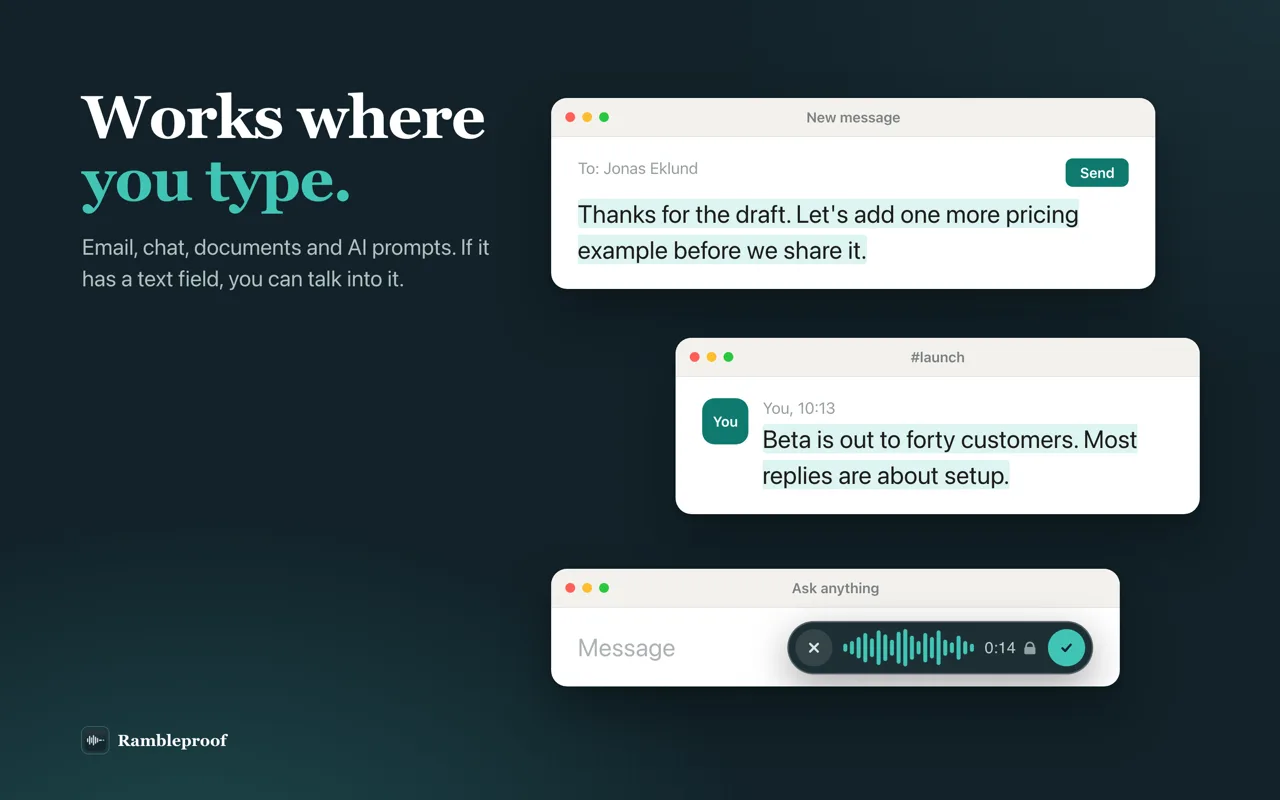
Most people type short prompts because typing a long one is tedious. Talking isn't. Rambleproof lets you press Right Option, ramble through what you want, press it again, and get clean text in Claude, Claude Code, your editor or the other apps you type in. It cleans up the ums and restarts. It runs on your Mac and has a free plan.
Rambleproof · free for Mac
Give Fable 5.2 the whole brief. Say it, don't type it.
Press Right Option, talk through the goal, the files, who owns the code and what done looks like. Press it again and clean text lands at your cursor in Claude, Claude Code or your editor.
Try Rambleproof freeUnlimited local dictation free, plus 15,000 AI-cleaned words a week. Apple silicon, macOS 15 or later.
Quick answers#
How much does Claude Fable 5.2 cost?
On the API, Claude Fable 5.2 costs $8 per million input tokens and $40 per million output tokens. Cache reads are $0.20 per million, the Batch API halves input and output to $4 and $20, and fast mode costs $16 and $80. That is 20% less than Fable 5.1 ($10 and $50) and twice the price of Opus 5.5 ($4 and $20).
What is the best effort level for Claude Fable 5.2?
High for most work. It is the API default, and on FrontierCode 2.0 it matched Opus 5.5's best score for about half the cost per task ($6.72 against $12.82). Use xhigh for the hardest long coding runs, where it scored highest of any model tested. Avoid max unless cost and time don't matter: on FrontierCode it scored lower than xhigh for about three times the cost.
Is Claude Fable 5.2 better than Opus 5.5?
On most benchmarks, yes. Fable 5.2 scored higher on 14 of the 16 results in Anthropic's summary table, including coding, research, computer use and freelance work. Opus 5.5 still leads on GDPval-AA and AA-Briefcase Elo, where human-style judges compare finished documents and slides, and it is half the price per token. Anthropic itself recommends starting with Opus 5.5 and moving up to Fable when Opus at higher effort is not enough.
Is Claude Fable 5.2 good at design?
It is very good at turning a visual reference into working code: it scored 74.1% on SWE-bench Multimodal, which adds screenshots and design mockups to coding tasks, against 61.4% for Opus 5.5, and 83.5% against 65.3% on BenchCAD, which rebuilds parts from engineering drawings. There is no taste or visual design benchmark in the system card, and on judged deliverables like slides and documents Opus 5.5 still scored slightly higher. Use Fable to build a design you already have, and test Opus 5.5 for open-ended visual ideas.
Can I use Claude Fable 5.2 in Claude Code?
Yes. Pick it with /model. Claude Code and the Claude apps run it on medium effort by default, one level below the API default of high. For real coding work, try high.
What is the Claude Fable 5.2 model ID and context window?
The API model ID is claude-fable-5-2 (anthropic.claude-fable-5-2 on Amazon Bedrock). It has a 1 million token context window, 128,000 max output tokens and a June 2026 knowledge cutoff. Adaptive thinking is always on.
What is the difference between Fable 5.2 and Mythos 5.2?
They are the same model. Fable 5.2 has stricter cybersecurity and biology safeguards and is available to everyone. Mythos 5.2 is for organizations verified through Anthropic's Cyber or Life Sciences Verification Programs. Both cost the same.
The short version#
Claude Fable 5.2 came out on November 9, 2026, at $8 in and $40 out per million tokens: 20% cheaper than Fable 5.1 and twice the price of Opus 5.5. It is the strongest model Anthropic sells to everyone, and it shows on long, hard, open-ended work.
Run it on high, not max. Keep Opus 5.5 for everyday coding, research reports and documents. Hand Fable the big jobs, the strange codebases and the designs you already have, and give it a proper brief.
I will put it through my own agent setup next and post the results on my YouTube channel. If you are deciding between the big models from both labs, my Claude Opus 5.5 vs GPT-6 Astra comparison covers the other side.
Published November 9, 2026, the day of release. Sources: Anthropic's Fable 5.2 announcement, the Claude Fable 5.2 and Mythos 5.2 system card, the model overview, what's new and pricing docs, Ethan Mollick, Matt Shumer, Claire Vo on Lenny's Newsletter, Atomic Agent and the Hacker News launch thread. Costs per task are Anthropic's estimates unless marked otherwise. This post is not sponsored by Anthropic. I will update it as more independent testing lands.
Moe shares tool walkthroughs and lessons from real projects. Mechanical engineer, then venture capital, now building AI tools for creators and small businesses. More about Moe