How to Tell Your Barber What Haircut You Want (Without the Photo Fail)
Showing a photo is not enough. Here is the exact language stylists actually need, section by section, plus what to say about your hairline, density and how much styling you will really do.
 By Moe Lueker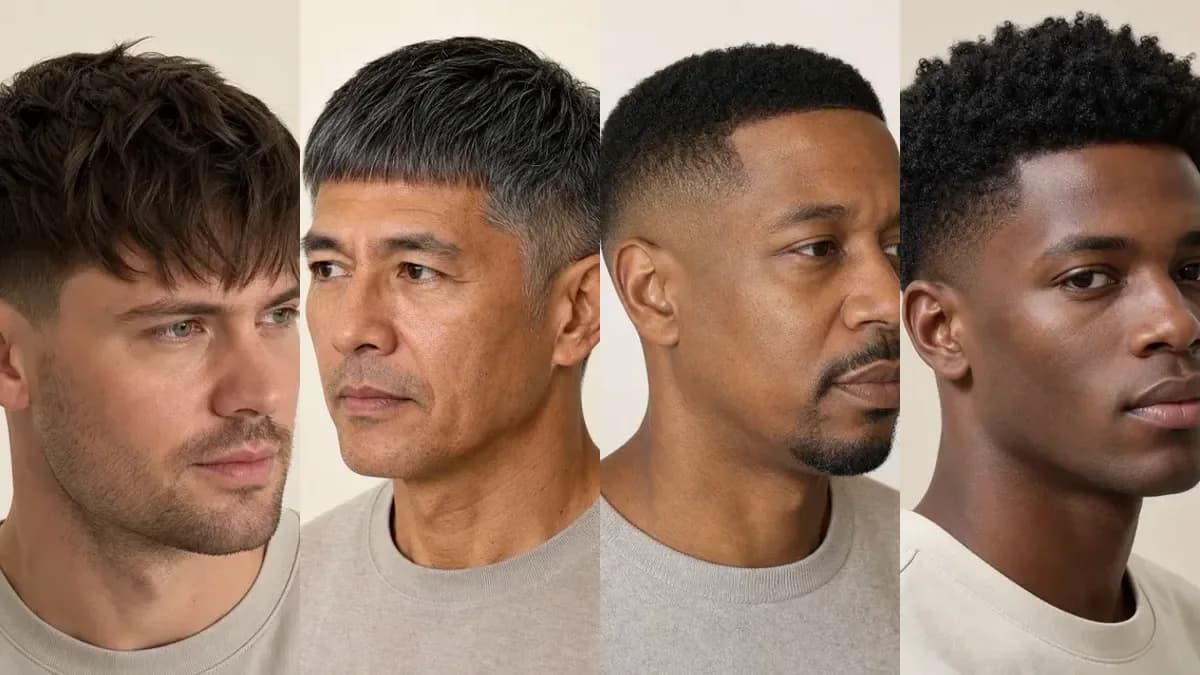
You found a photo. You showed it. You got something else.
That is the single most common haircut complaint, and it is almost never because the stylist was careless. It is because a photo answers one question (what do you like?) and leaves four unanswered: where do you start from, what does your hair actually do, how much effort will you put in, and what should they absolutely not do.
Here is how to close that gap.
Why the photo alone fails#
A photo of a haircut is a photo of that haircut on someone else's hair. Their density, curl pattern and hairline are baked into what you are pointing at. When your hair is finer, or curlier, or your hairline sits further back, the same cut lands differently, and your stylist has to guess which part of the picture you actually wanted.
Worse, most reference photos are styled. They are a blow-dry, product and good lighting on top of the cut. If you want to look like that on a Tuesday morning, somebody needs to tell you that out loud before the scissors come out.
The five things to say#
1. Where you are starting from#
Say your current length in plain words, and whether you are willing to grow it out. "This is about four months of growth and I would rather not go longer" is more useful than any photo.
If a cut needs length you do not have, that is not a no. It is a timeline. Ask "how long until I could have this?" and you will get a real answer.
2. What your hair actually does#
Three facts, in this order:
- Curl pattern. Straight, wavy, curly or coily. Not what it looks like after you style it. What it does when it dries on its own.
- How much of it there is. Fine, average or thick. Say it plainly. A good stylist would rather hear "it is thinner than it looks here" than discover it.
- Where your hairline sits. If it has receded at the temples, say so. It is the single most useful thing you can tell a barber, because it changes which cuts work and which ones point straight at it.
None of that is a confession. It is a spec.
3. The cut, section by section#
This is the part people skip, and it is the part that decides the result. Give them four numbers or four descriptions:
- Sides — clipper grade, or "scissor over comb, no clipper line"
- Back — same as the sides, or tapered into the neck
- Top — a length in centimetres or finger-widths, not "a bit off"
- Fringe — forward, swept, or none at all
Then the neckline: natural, tapered, or squared. It sounds fussy. It is the difference between a cut you like and a cut you tolerate for six weeks.
4. How much styling you will really do#
Be honest, not aspirational. "I will spend two minutes and I own one product" is a completely respectable answer, and it changes what a stylist should cut.
A cut that needs ten minutes of blow-drying to look right will look wrong every single day you do not do it. Say the real number and let them design around it.
5. What to avoid#
Everyone has one. Say it up front.
"Do not thin the ends." "Do not take the sides above my temple." "Last time it was cut too short at the back and I hated it." "Do not touch the length at the front."
Stylists want this. It is the cheapest possible way to avoid a bad appointment, and it costs you one sentence.
The two questions worth asking them#
Once you have said your piece, ask:
- "Will this work with my hair, honestly?" A good stylist will tell you if your density or curl pattern is going to fight the shape. Believe them.
- "What will it look like in six weeks?" Every cut grows out. Some grow out gracefully and some fall apart. Knowing which one you are choosing is worth more than the first-day photo.
A shortcut, if you want one#
I built a tool that does this part for you. You upload a photo, it reads your actual length, texture, density and hairline, you correct anything it got wrong, and it produces a plan with all five sections filled in — plus previews of the cut on your own face so you can see whether you like it before you commit.
The plan is free, and you can hand it to your stylist as a link or print it out.
Try it here, or browse the cuts first if you are still deciding. If you are not sure what suits you, start here instead.
The short version#
Bring the photo. Then say five things: where you are starting from, what your hair does, the cut section by section, how much styling you will actually do, and the one thing you never want done.
That is the whole trick. It is not about knowing haircut vocabulary. It is about answering the questions the photo cannot.
Moe shares tool walkthroughs and lessons from real projects. Mechanical engineer, then venture capital, now building AI tools for creators and small businesses. More about Moe