Reverse Engineer Anything (REA): What It Is and Why It Exploded
Reverse Engineer Anything (REA) went from 41 to 300K+ GitHub stars in 15 days. What it is, what's actually new, how to install it and what it found in my app.
 By Moe Lueker
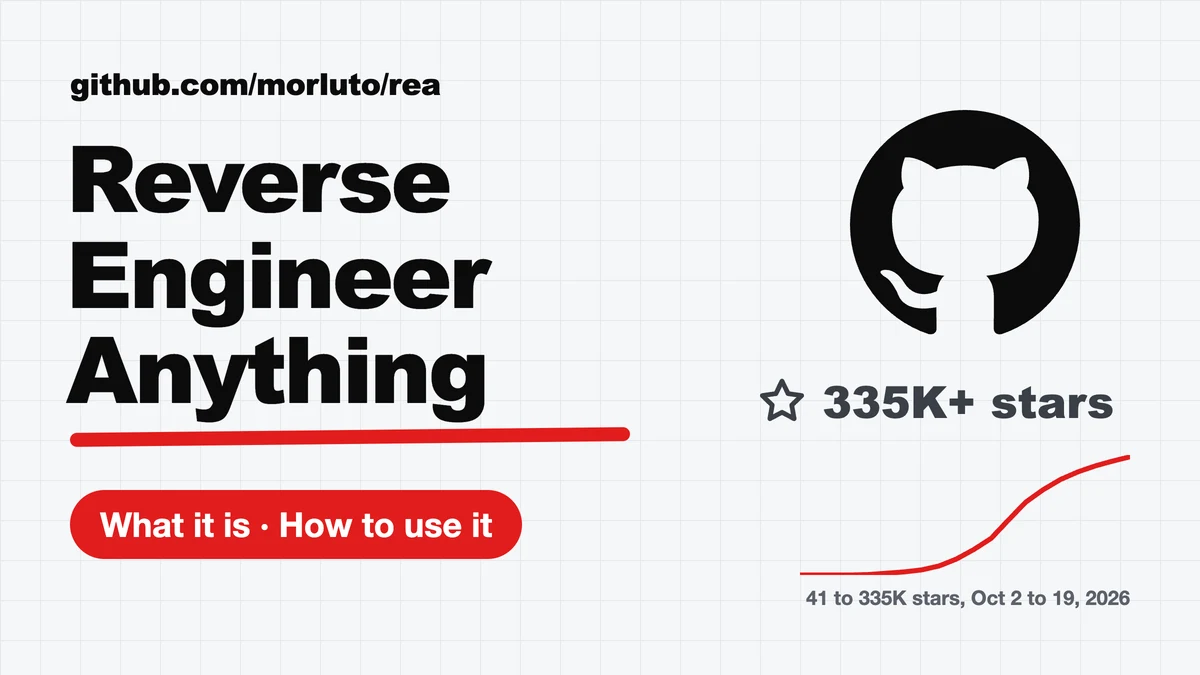
Reverse Engineer Anything (REA) is a free, open-source tool that lets a coding agent like Claude Code or Codex look inside software it has no source code for and explain how a feature works. It connects the agent to reverse engineering tools such as Ghidra, Hopper, IDA, a browser and runtime capture through one MCP server. You ask in plain English. You get back a reconstruction of the logic, the evidence for each claim and a list of what it couldn't work out. You don't get the original source code.
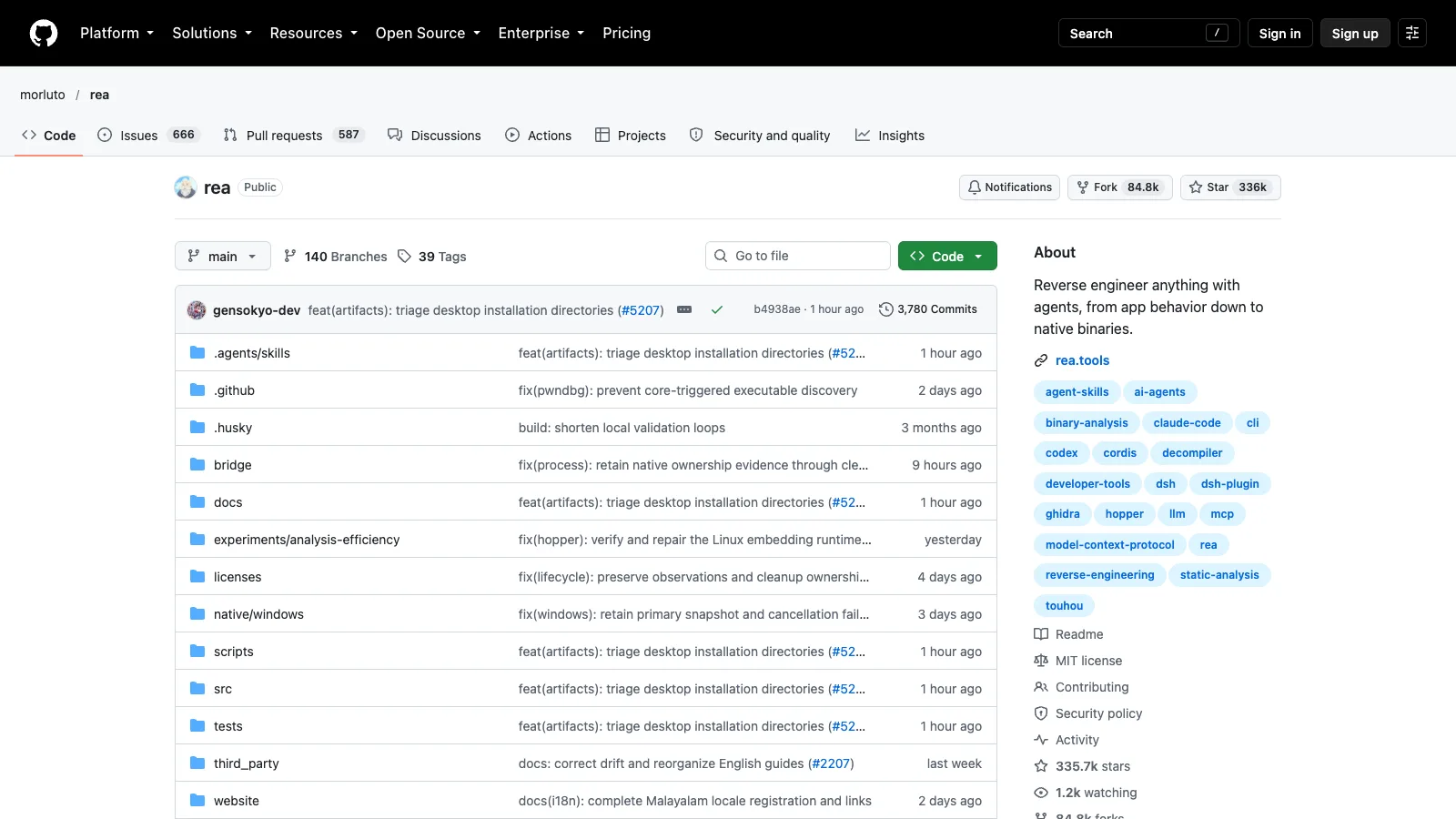
It is also the fastest-growing repo I've watched on GitHub. On October 2, 2026 it had 41 stars. On October 19 it had 335.7K. I used it on my own Mac app for a video, so this post mixes the public numbers with what I saw first-hand.
REA's GitHub stars over time#
The repo was created on April 14, 2026, and sat almost unnoticed for months. GH Archive records its first star event on August 14 and only 34 stars by the end of September. Then it went vertical.
Show the data and method
Daily totals come from OSS Insight’s star history for morluto/rea, which counts GH Archive star events per UTC day (fetched October 19, 2026, 1:58 pm PT; October 19 is a partial day). Hollow dots are GitHub’s own star count read at the listed times: 157,134 (Oct 12, 5:50 pm PT), 320,274 (Oct 18, 12:45 pm PT) and 335,538 (Oct 19, 1:53 pm PT). The two sources line up within about 1%.
| UTC day | Total stars | New that day |
|---|---|---|
| 2026-09-30 | 34 | |
| 2026-10-01 | 34 | 0 |
| 2026-10-02 | 41 | 7 |
| 2026-10-03 | 123 | 82 |
| 2026-10-04 | 1,550 | 1,427 |
| 2026-10-05 | 5,139 | 3,589 |
| 2026-10-06 | 8,895 | 3,756 |
| 2026-10-07 | 14,572 | 5,677 |
| 2026-10-08 | 25,576 | 11,004 |
| 2026-10-09 | 45,151 | 19,575 |
| 2026-10-10 | 71,920 | 26,769 |
| 2026-10-11 | 103,644 | 31,724 |
| 2026-10-12 | 155,617 | 51,973 |
| 2026-10-13 | 206,475 | 50,858 |
| 2026-10-14 | 241,667 | 35,192 |
| 2026-10-15 | 270,604 | 28,937 |
| 2026-10-16 | 292,245 | 21,641 |
| 2026-10-17 | 309,062 | 16,817 |
| 2026-10-18 | 322,853 | 13,791 |
| 2026-10-19 | 334,833 | 11,980 |
The curve has three phases you can read straight off the data:
- Ignition, October 3 to 8. 123 stars became 25,576. Developers found it and shared it.
- The explosion, October 9 to 13. It added more than 19,000 stars a day, peaking at 51,973 on October 12 (UTC). It crossed 100,000 on October 11 and 200,000 on October 13.
- The long tail, October 14 onward. Still 12,000 to 35,000 new stars a day, but falling every day. It passed 300,000 on October 17.
GitHub's own star counter agreed. I read 157,134 stars on the evening of October 12, 320,274 at lunchtime on October 18, and 335,538 on the afternoon of October 19. Each of those sits within about 1% of the GH Archive line.
Stars are a vanity metric, so I also checked installs. The setup package, rea-agents, did more than 100,000 npm downloads a day on October 12 and again on October 16, 17 and 18. People weren't just starring it. They were running it.
Why REA got so popular#
The pitch is one sentence#
"See a feature you like. Understand how it works, down to the binary level." That's the line at the top of the README, and it lands with anyone who has ever wondered how an app does something. You don't need to know what a decompiler is to want that.
The demos did the marketing#
YouTube carried it. As of October 19, Low Level's "I Tested The Viral Reverse Engineering Repo" had 2.35 million views, Nick Saraev's test of "the viral GitHub repo that reverse engineers anything" had 1.53 million, Rob Shocks had 491,000 and Eric Tech's "How To Use REA To Clone Any Software In Minutes" had 337,000.
It also rode a bigger wave. Fireship's "Every app on Earth is now open source" passed 6.2 million views, mostly about the free Adobe rebuilds. Those apps were rebuilt from scratch, not reverse engineered with REA, but the two stories blurred together into one idea: closed software isn't closed anymore.
Coding agents were finally ready#
Since early 2025 an agent could call Ghidra through an MCP server, but you had to wire it up by hand and know what to ask. Coding agents are now good enough to plan a multi-step investigation on their own. Models have improved fast at this kind of work: OpenAI reported 88.0% for GPT-6 Astra on SRE-Bench, a binary reverse-engineering benchmark, against 55.9% for GPT-5.6 Sol. I break those numbers down in my GPT-6 Astra benchmark post.
Setup is one line#
npx rea-agents setup registers REA with your agents and installs matching instructions. No plugin to compile, no Python environment. Low friction plus a fun demo is how a repo gets 50,000 stars in a day.
What's genuinely new, and what isn't#
Most of REA's power is old. Decompilers have existed for decades. The NSA released Ghidra as free, open-source software in March 2019. GhidraMCP, which lets an AI call Ghidra's functions, appeared in March 2025.
- Years beforeDecompilers like IDA Pro and HopperPaid tools, used by experts by hand
- Mar 2019The NSA open-sources GhidraA free, pro-grade decompiler for everyone
- Mar 2025GhidraMCPAn MCP server that lets an AI call Ghidra's functions
- Apr 14, 2026The REA repo is createdREAOne MCP for binaries, apps, sites and runtimes
- Jul 12, 2026rea-agents lands on npmREAnpx rea-agents setup wires it into your agent
- Oct 3 to 13, 2026REA goes viralREAFrom 123 to 206,475 stars in ten days
What REA adds is the orchestration around those tools:
- One MCP for many target types. Native binaries, JavaScript and Electron apps, websites, .NET assemblies, Android APKs, firmware, saved network captures and more, each routed to the right tool.
- Evidence and unknowns as the output format. Every finding carries the evidence behind it, and the agent can record what it could not resolve instead of guessing.
- Agent instructions included. Setup installs a skill that tells your agent how to run an investigation, not just which tools exist.
Here's how it compares with the tools people used before:
| REA | Ghidra alone | GhidraMCP | Plain coding agent | |
|---|---|---|---|---|
| Who drives it | Your agent, in plain English | You, by hand | Your agent | Your agent |
| Targets | Native, JS/Electron, web, .NET, Android, firmware and more | Native binaries | Native binaries (through Ghidra) | Whatever it can read as text or see in screenshots |
| What you get | Reconstruction, evidence, unknowns | Pseudocode and assembly | Decompiled code, renamed functions | A plausible guess or rebuild |
| Shows what it couldn't see | Yes, as a ledger of unknowns | Up to you | Up to you | Only if you ask |
| Setup | npx rea-agents setup | Install Ghidra and a JDK | Ghidra plus a plugin and MCP config | None |
| Cost | Free (MIT) plus model usage | Free | Free plus model usage | Model usage |
Feature lists come from each project's README on GitHub, read October 19, 2026.
The honest caveat: for simple jobs, a plain coding agent can often do the same work. Two of the creators I studied before my video found a regular agent as fast or faster on small targets. That matched my own read. REA earns its place when you need to see what the code really does, with proof.
How to install REA#
You need Node.js 22.19+ (or 24.11+, or 26+) and npm. Then:
npx rea-agents setup
Pick your agents (Claude Code, Codex, Cursor, Gemini CLI and others are supported), review the changes and approve. Setup backs up your config first. Restart your agent afterward.
For native apps you also need a decompiler. Ghidra is free. Hopper is paid with a demo, and setup can install it after you approve. IDA works if you already have it. JavaScript, Electron and .NET analysis need none of them.
Or skip the terminal and ask your agent to do it. Paste the GitHub link and say: "Install REA from this repo for Claude Code on my Mac, and tell me if it needs Ghidra or Hopper." I put that prompt, a free Ghidra setup prompt and 11 more into a free starter guide.
How to use REA well#
These are the habits that made my run useful:
- Use an empty folder. Put only the app inside a
targetfolder. If the agent can see your source, it will "discover" what it already knows. - Ask about one feature. "How does this app turn text into speech?" works. "Rebuild this whole app" doesn't.
- Ask for three buckets. Tell it to sort every claim into what it can prove, what it infers and what it can't see. This is where REA beats a plain agent.
- Raise the timeout on big binaries. The README lists
REA_GHIDRA_STARTUP_TIMEOUT_MSandREA_HOPPER_STARTUP_TIMEOUT_MSfor large files. I wish I had set it before my run. - Keep approvals on. REA runs with your permissions and is not a sandbox. A file you inspect can contain text aimed at your agent.
- Update often. The project ships fixes constantly. Rerun
npx rea-agents@latest setupwhen something breaks.
What REA found in my own app#
I pointed REA at HoverSpeech 0.1.3, a free text-to-speech Mac app I built, in an empty folder with my source code blocked. Ghidra timed out twice, after 330 seconds each, on the app's 16 MB helper file. So the agent fell back to labels, the file list and type names.
It still identified the speech model (Kokoro-82M through the FluidAudio library), the voice it uses ("Heart"), and that the model downloads on request instead of shipping in the app. Its report had 24 proven claims, 7 inferences and 7 things it couldn't see.
Then Claude rebuilt the read-aloud feature as a web page and put it online. The whole run used about 56 million tokens, roughly $28.60 at API prices, or 2% of my weekly Claude plan. The full step-by-step, with screenshots and every prompt, is in how to use REA: I cloned my own app and put it online. You can try the page it built.
Is REA legal?#
The project's own position: REA is for lawful research, education, interoperability, software preservation and analysis of software you own or are authorized to examine. Commercial tools like IDA and Hopper still need proper licenses. Point it at your own software, or software you have permission to inspect, and read the license of anything you analyze. This isn't legal advice.
If what you really want is your own version of a tool, forking an open-source app is often the cleaner path. I did exactly that when I built my own dictation app with Claude Code and Gladia.
REA FAQ#
What is Reverse Engineer Anything (REA)?
REA is a free, MIT-licensed tool on GitHub (morluto/rea) that connects coding agents like Claude Code and Codex to reverse engineering tools such as Ghidra, Hopper, IDA, a browser and runtime capture through one MCP server. You ask about a feature in plain English, and the agent returns a reconstruction of how it works, the evidence for each claim and a list of what it could not work out.
Does REA give you the original source code?
No. Once an app is compiled, the original source is gone. Native analysis returns pseudocode and assembly, and JavaScript or Electron analysis recovers modules and how they connect. Your agent uses those findings to write its own version.
Is REA free?
Yes. REA is open source under the MIT license. You pay for your coding agent's model usage, and Hopper and IDA are paid tools if you choose them. Ghidra is free. My run on my own Mac app used about 56 million tokens, roughly $28.60 at API prices, or 2% of my weekly Claude plan.
How do I install REA?
With Node.js 22.19+, 24.11+ or 26+ installed, run npx rea-agents setup, pick your agents, review the proposed changes and restart your agent. You can also paste the GitHub link into Claude Code or Codex and ask it to install REA for you.
Do I need Ghidra or Hopper?
Only for native apps. Deep native analysis uses Hopper, Ghidra or IDA. Static JavaScript, Electron and .NET inspection work without one. Setup can install Hopper after you approve it; Ghidra and IDA use installs you already have.
Is it legal to use REA?
The project says REA is for lawful research, education, interoperability, preservation and software you own or are authorized to examine. Point it only at software you own or have permission to inspect, and check the license of anything you analyze. This is not legal advice.
Does REA upload my app?
According to the project, REA analyzes targets locally. Your agent receives the tool results, and the agent's model provider has its own data policy.
How many GitHub stars does REA have?
335.7K stars and 84.8K forks on October 19, 2026. It went from 41 stars on October 2 to over 100,000 on October 11, per GH Archive star events.
The takeaway for anyone who ships software: a compiled app is no longer much of a lock. What protects your product now is what runs on your servers, your users and your distribution.
Some links above are affiliate links, so I may earn a commission at no extra cost to you. I only recommend tools I actually use.
Moe shares tool walkthroughs and lessons from real projects. Mechanical engineer, then venture capital, now building AI tools for creators and small businesses. More about Moe