Gemini 4 Neon vs Opus 5.5 vs GPT-6.2: 5 Design Jobs, Scored Blind
Gemini 4 Neon beat Claude Opus 5.5 and GPT-6.2 in my blind test of five design jobs, 180 points to 164. Play all 20 builds and see what each one cost.
 By Moe Lueker
Gemini 4 Neon won my blind test. I gave Google's new model, Claude Opus 5.5, GPT-6.2 Astra and GPT-6.2 Sol the same five design jobs, scored all 20 builds without knowing who made which, and Neon came out on top with 180 points to Opus's 164.
The second surprise was the price. Astra finished just 5 points behind Opus and cost about a third as much: $4.20 for all five builds against $12.10.
Which AI model is best right now? For front end and visual design, Gemini 4 Neon was the best model in my test. For everyday work I'm keeping Claude Opus 5.5, because I know how reliable it is. For long-running agents that need brains more than front end, GPT-6.2 Astra gives you nearly the same quality for far less. Sol was the cheapest at $2.58, but it finished well behind.
- 1. Gemini 4 Neon (xhigh)180 points · $11.07 · 86 minRounds won: Glass bottle, pitch deck, landing page (near tie)
- 2. Claude Opus 5.5 (high)164 points · $12.10 · 41 minRounds won: Space lander (tie on points)
- 3. GPT-6.2 Astra (high)159 points · $4.20 · 23 minRounds won: SVG surfer print
- 4. GPT-6.2 Sol (xhigh)133 points · $2.58 · 53 minRounds won: None
Cost is API-equivalent at standard list prices, from each run's token logs. The builds ran on my subscriptions. Build times are approximate.
How I ran the blind test#
Each model ran in its own coding agent: Codex for GPT-6.2 Astra and Sol, Claude Code for Opus 5.5 and Antigravity for Gemini 4 Neon. Every run got a fresh copy of the same project in its own folder and the exact same prompt. One run each, no reruns and no human fixes. The prompts could be better, but I wanted them identical so the test stays fair.
The five jobs:
- A 3D glass perfume bottle you can spin, with a light you can move
- A launch page for Rambleproof, my Mac dictation app
- A three-slide pitch deck for a museum's late-night program, as an editable PowerPoint
- An SVG print of a surfer riding a wave at Mavericks, with a moving version
- A small 2D space game where you land a ship
I scored each build out of 50 while it only had a letter, A to D. Only after scoring a round did I reveal who built it, what it cost and how long it took.
Two things to keep in mind. Gemini 4 Neon ran at extra high effort, while Astra and Opus ran at high, and that shows in Neon's build times. GPT-6.2 Sol also ran at extra high. And the costs are API-equivalent: I priced each run's token log at the standard list rates, but every build ran on my subscriptions, so nobody actually paid these amounts.
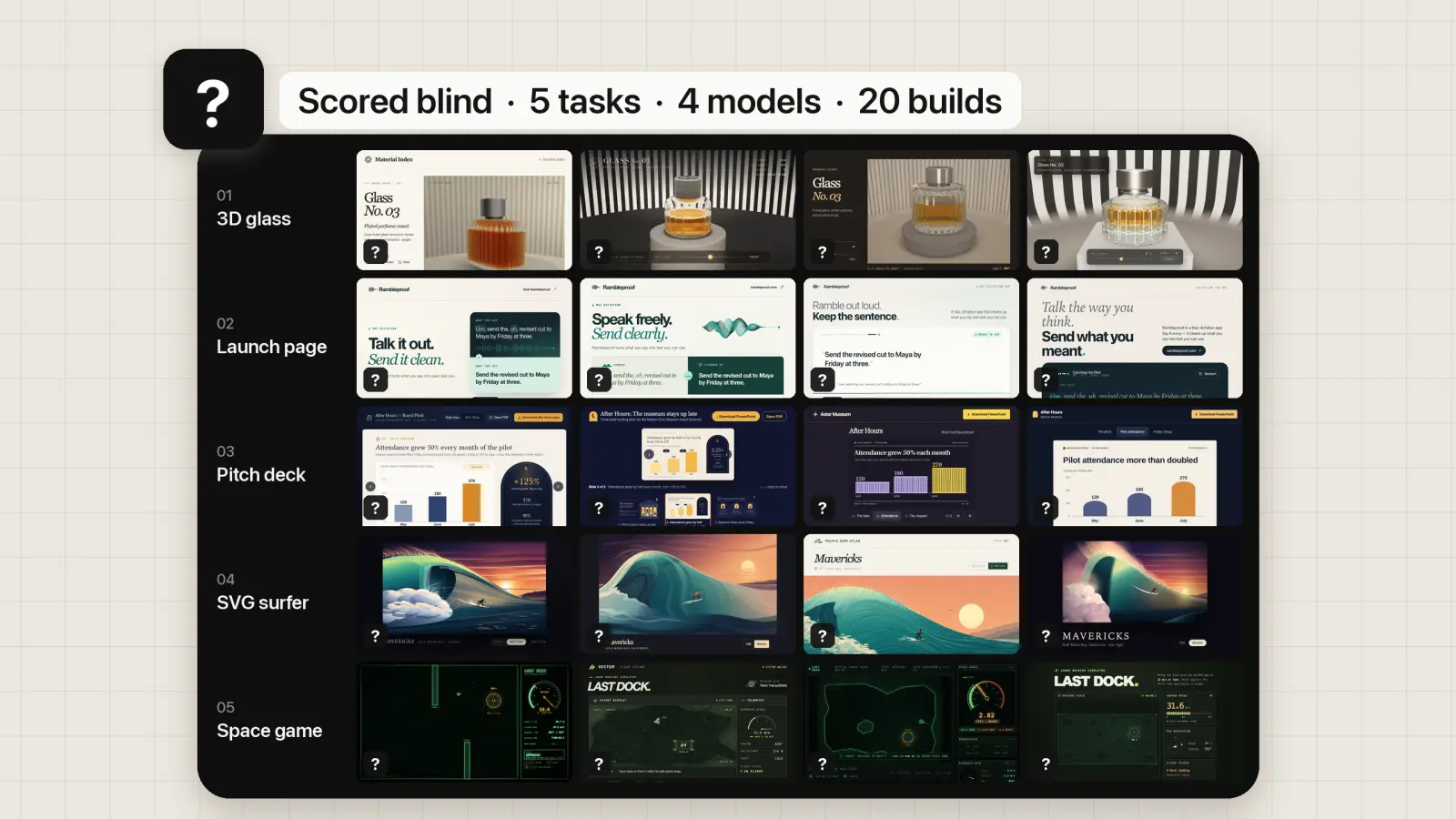
Play all 20 builds yourself#
These are the original files each model produced, untouched. Pick a round, press play on any build, and it loads live right here. Start blind if you want to test your own taste, then reveal who built what.
Build A · 26 of 50 points
Open full screenDrag to orbit the bottle and move the key light.
Pick a build to play it. Then reveal who built what. Builds are the models' original files with no fixes. Costs are API-equivalent at list prices; the runs used my subscriptions.
No model won every round. That's the main thing I took from this test, and it's why I've stopped using one model for everything. My own AI agents run on Gamut, which sponsored this video, and I'm grateful they did, because it fits the result so well. Each agent runs on its own model, so my design agent can sit on Gemini 4 Neon while a long research job runs on GPT-6.2 Astra. Both GPT-6.2 models were in Gamut on launch day, and if you already pay for ChatGPT, Claude or Grok, you can connect that plan so your agents run on it. I wrote up what my six-agent team there did in four days in my Gamut AI review, and you can watch that video here.
Sponsor · Gamut
No model won every round. So pick one per agent.
Gamut runs AI agents on the model you choose for each one: Opus 5.5, GPT-6.2 Astra and Sol, or Gemini 4 Neon. You can also connect a ChatGPT, Claude or Grok plan you already pay for.
Get $100 in free creditsFree to start. Gamut sponsored the video this post is based on.
Round 1: 3D glass perfume bottle#
| Build | Model | Points | API cost | Build time |
|---|---|---|---|---|
| D | Gemini 4 Neon | 41 | $3.09 | 21 min |
| B | Claude Opus 5.5 | 32 | $3.36 | 11 min |
| A | GPT-6.2 Astra | 26 | $1.01 | 6 min |
| C | GPT-6.2 Sol | 11 | $0.55 | 11 min |
Gemini 4 Neon's bottle had the best visual style by a distance. When I moved the key light, the whole shading and the shadow changed, and you could even see the straw inside the bottle. It also let me orbit up and down, which Astra's and Sol's didn't. Opus was a close second: more immersive than a page with a frame in it, with the striped background reflecting nicely on the glass. Astra's page looked clean and rendered fast, but I couldn't move up or down or zoom. Sol's render looked grainy and left a big gap at the bottom.
None of the four made the liquid slosh. The GPT models cost a fraction of the other two here.
Round 2: Rambleproof landing page#
| Build | Model | Points | API cost | Build time |
|---|---|---|---|---|
| C | Gemini 4 Neon | 38 | $2.08 | 17 min |
| D | Claude Opus 5.5 | 36 | $1.84 | 6 min |
| A | GPT-6.2 Sol | 33 | $0.52 | 10 min |
| B | GPT-6.2 Astra | 33 | $0.88 | 4 min |
This was the hardest one to call, and on camera I called it a tie. All four pages would work. None of them was overly wordy, and every demo showed messy speech turning into clean text.
Neon got the most points for its attention to detail: a double-radius border and waveforms that move together with the text, which is exactly how Rambleproof works. Opus's demo typed the words as I spoke, then crossed out the filler and cleaned it up. I just didn't love its font. Astra's waveforms and crossed-out words looked good, but its demo felt slow. Sol's was clean and simple.
Astra built its page in under four minutes for 88 cents. Neon took 17 minutes and was the most expensive in this round.
Rambleproof is the app all four were selling. It's my free dictation app for Mac, and it's how I talk through the long prompts I give every model in this test instead of typing them.
Rambleproof · free for Mac
The app from round 2. Talk, and clean text lands at your cursor.
Press Right Option, talk through what you want, press it again. Rambleproof cleans up the ums and restarts and pastes the text into the app you are in: Claude, ChatGPT, Gmail, Slack or your code editor. It's how I write long prompts for every model in this test.
Try Rambleproof freeUnlimited local dictation free, plus 15,000 AI-cleaned words a month. Apple silicon, macOS 15 or later.
Round 3: Pitch deck#
| Build | Model | Points | API cost | Build time |
|---|---|---|---|---|
| A | Gemini 4 Neon | 35 | $1.62 | 13 min |
| B | Claude Opus 5.5 | 32 | $1.83 | 6 min |
| C | GPT-6.2 Astra | 32 | $0.72 | 4 min |
| D | GPT-6.2 Sol | 27 | $0.51 | 10 min |
I asked for a three-slide pitch for a museum's Friday night program, as a real PowerPoint file plus a PDF. Neon's deck had the most attention to detail, although it was a bit wordy, and a clear em dash on one slide gave it away as AI. Opus picked nicer colors but put "+50%" in the wrong place on its chart, a real mistake. Astra's deck was simpler and could still work. Sol's was the weakest in my opinion; the other three were close.
Astra was the fastest again: about four minutes against Neon's 13.
Round 4: SVG surfer print#
| Build | Model | Points | API cost | Build time |
|---|---|---|---|---|
| C | GPT-6.2 Astra | 29 | $0.76 | 5 min |
| A | Gemini 4 Neon | 28 | $2.47 | 20 min |
| B | GPT-6.2 Sol | 28 | $0.55 | 11 min |
| D | Claude Opus 5.5 | 25 | $2.54 | 9 min |
This was the upset. Claude Opus 5.5, my daily driver, came last, and GPT-6.2 Astra won.
Astra's print had real attention to detail: lots of small strokes in the wave, and in the motion version, spray coming off the lip. Neon had the colors I liked most and a stylish wave, but its motion version moved the wrong way. Sol's wave and sunset looked artistic, but the surfer looked awkward and the Mavericks setting was missing. Opus went for a glowy look with puffy clouds, and its wave looked the least like a wave.
For SVG work, I'd now pick Gemini 4 Neon or GPT-6.2 Astra.
Round 5: Space lander game#
| Build | Model | Points | API cost | Build time |
|---|---|---|---|---|
| A | Claude Opus 5.5 | 39 | $2.53 | 9 min |
| B | GPT-6.2 Astra | 39 | $0.83 | 5 min |
| C | Gemini 4 Neon | 38 | $1.81 | 14 min |
| D | GPT-6.2 Sol | 34 | $0.45 | 11 min |
Opus and Astra tied on points, and I gave the round to Opus: it had the best look and the easiest control feel. Neon was one point behind. The GPT models cost well below the other two, and Astra was the fastest for the fifth time in five rounds.
If you want to see how these models handle bigger games, I ran Claude Opus 5.5 against GPT-6 Astra on two full game builds (video), and I put the same models to work on 3D escape rooms you can play, where Neon built the best room of any single model (video).
Cost and build time per round#
Here is every number from the test in one place. Points are out of 50 per round.
| Round | Gemini 4 Neon | Claude Opus 5.5 | GPT-6.2 Astra | GPT-6.2 Sol |
|---|---|---|---|---|
| Glass bottle | 41 pts, $3.09, 21 min | 32 pts, $3.36, 11 min | 26 pts, $1.01, 6 min | 11 pts, $0.55, 11 min |
| Landing page | 38 pts, $2.08, 17 min | 36 pts, $1.84, 6 min | 33 pts, $0.88, 4 min | 33 pts, $0.52, 10 min |
| Pitch deck | 35 pts, $1.62, 13 min | 32 pts, $1.83, 6 min | 32 pts, $0.72, 4 min | 27 pts, $0.51, 10 min |
| SVG surfer | 28 pts, $2.47, 20 min | 25 pts, $2.54, 9 min | 29 pts, $0.76, 5 min | 28 pts, $0.55, 11 min |
| Space lander | 38 pts, $1.81, 14 min | 39 pts, $2.53, 9 min | 39 pts, $0.83, 5 min | 34 pts, $0.45, 11 min |
| Total | 180 pts, $11.07, 86 min | 164 pts, $12.10, 41 min | 159 pts, $4.20, 23 min | 133 pts, $2.58, 53 min |
Neon and Opus landed within about a dollar of each other. Astra got within 5 points of Opus for about a third of the price, and Sol cost roughly half of what Astra did but finished 26 points behind it. Sol also took longer than Astra, partly because I didn't run it in a fast mode. On a cheaper subscription plan, it will still go a long way.
Neon was the slowest by far, at almost four times Astra's build time. Part of that is the extra high effort setting. If you want the API prices, thinking levels and benchmark cost per task behind these models, I broke them down in Gemini 4 Neon pricing and benchmarks and in GPT-6.2 Astra and Sol price and benchmarks.
Which AI model I'm keeping#
Claude Opus 5.5 stays my daily driver. I know how reliable it is, and it does a good job most of the time.
Gemini 4 Neon is my pick for front end and design. I've used other Gemini models before, and this one feels different. It won three of five rounds on looks and detail. I still need to test it on back-end work and more complex apps.
GPT-6.2 Astra is the value pick. For long-running agents that need a lot of intelligence but not much front end, I might move them to Astra, because the cost for the quality is just better.
So I'm pairing Opus with Neon and Astra instead of picking one winner. Set up that way, each job goes to the model that did it best in my test.
Questions about Gemini 4 Neon vs Opus 5.5 vs GPT-6.2#
Is Gemini Neon better than Claude Opus 5.5?#
For design work, yes, in my blind test. Gemini 4 Neon scored 180 of 250 points to Opus 5.5's 164 and won the glass bottle and the pitch deck outright. Opus won the space lander game and is still my pick for everyday work.
How much did each model cost for the five builds?#
At API list prices: Claude Opus 5.5 $12.10, Gemini 4 Neon $11.07, GPT-6.2 Astra $4.20 and GPT-6.2 Sol $2.58. I ran them on subscriptions, so these are API-equivalent costs from the token logs.
Was the test fair to every model?#
Every model got the same prompt, a fresh project folder and one run with no fixes, and I scored the builds before I knew who made them. The effort levels weren't identical: Neon ran at extra high, Astra and Opus at high. One run per job is also a small sample, so treat this as a hands-on test, not a benchmark.
Rambleproof, the app from round 2#
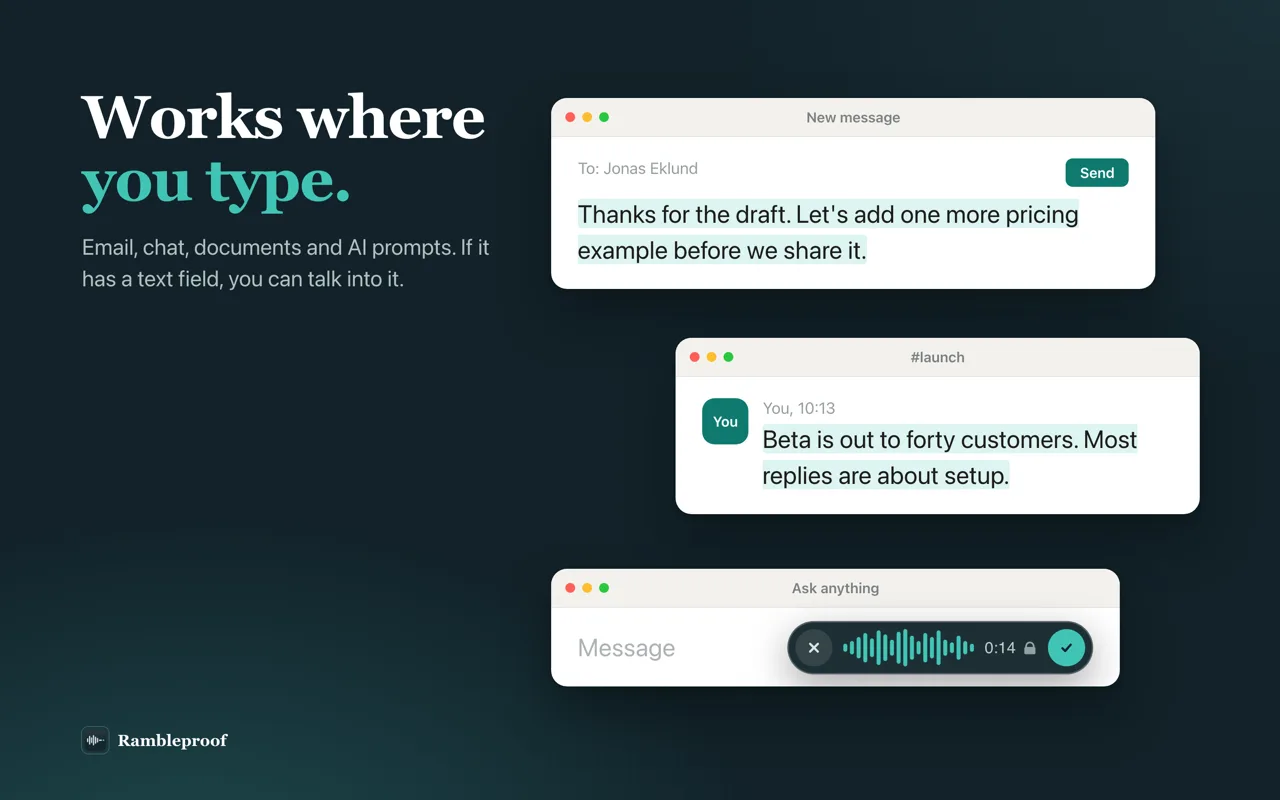
Every long prompt in this test started as me talking, not typing. Rambleproof is the dictation app I built for that. Press Right Option, ramble through what you want, press it again, and clean text lands at your cursor in Claude, ChatGPT, Gemini, Gmail or the other apps you type in.
Gamut sponsored the video this post is based on, and the Gamut links above are its tracking links. Rambleproof is my own app.
Watch the full walkthrough on YouTube: https://youtu.be/rQGGLpmzqO4
Moe shares tool walkthroughs and lessons from real projects. Mechanical engineer, then venture capital, now building AI tools for creators and small businesses. More about Moe
Get new videos in your inbox
Weekly AI workflows. No fluff.
No spam. Unsubscribe anytime.