

Not every receding hairline needs the same haircut
Two open corners with strong density through the middle are a different design problem from a thinning crown. Choose the cut based on where the contrast sits, not only the label.
- 1Receding templesTry a crop, irregular fringe, crew cut, or an open buzz cut.
- 2Widow's peakWork with the central point using texture, a side direction, or a clean short cut.
- 3High foreheadUse a soft fringe or controlled forward direction if the front has enough length.
- 4Thinning across the topReduce length and contrast instead of building a long section over the area.
Eight cuts, and what each one is really doing

Buzz cut
- Why it can work
- Reduces the contrast between shorter temple areas and the rest of the hair.
- Best starting point
- Receding temples, diffuse thinning, or anyone ready to show the full outline.
- The honest catch
- It reveals the exact hairline and head shape, which is why an honest preview matters.

French crop
- Why it can work
- A short, irregular fringe breaks up the front edge instead of drawing one hard line.
- Best starting point
- Receding corners with enough density and length through the center front.
- The honest catch
- A dense straight fringe can look like a cover-up if the corners are too open.

Textured crop
- Why it can work
- Separated pieces create movement without needing a tall, full front section.
- Best starting point
- Straight or wavy hair with mild temple recession.
- The honest catch
- Texture should come from cutting and styling, not invented curl or extra density.

Caesar cut
- Why it can work
- Keeps the top short and directs a small amount forward across the front.
- Best starting point
- A mature or slightly receded line with fairly even density on top.
- The honest catch
- The front edge should stay soft. A sharp line can exaggerate uneven corners.

Crew cut
- Why it can work
- Keeps controlled height near the front without relying on a long quiff.
- Best starting point
- A mature hairline with stronger density through the center and crown.
- The honest catch
- Too much height with very tight sides can point directly at the temple recession.
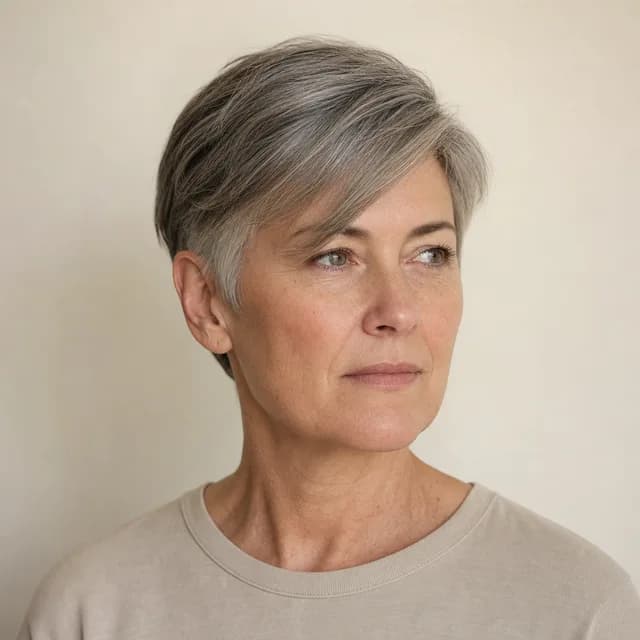
Side-swept fringe
- Why it can work
- Uses a diagonal direction rather than trying to build an even wall across the forehead.
- Best starting point
- A high forehead, widow's peak, or one corner that sits differently from the other.
- The honest catch
- It needs enough front length and can separate in wind or humidity.

Classic taper
- Why it can work
- Keeps the sides neat without removing all the visual support at the temples.
- Best starting point
- A mature hairline and a professional, low-drama result.
- The honest catch
- Ask for a low, conservative taper. A high fade can expose more recession than expected.

Short slick back
- Why it can work
- Treats the hairline as part of the look instead of pretending it is elsewhere.
- Best starting point
- People who prefer an open forehead and have enough density to direct the top back.
- The honest catch
- Shine and tight combing can expose scalp. A softer finish is often more forgiving.
When the preview quietly improves the temples
This French crop result looks believable at first glance. The automated benchmark still marked the hairline down because the corners became slightly fuller. That is exactly the kind of flattering change a haircut decision should call out.
 50 percent of the after image is visible. The same fictional man with a French crop that slightly fills the temple corners
Attractive is not the same as accurate
The front-preview judge scored this hairline 4 out of 5. The three-angle version scored it 2 out of 5 because the temple corners were made younger and fuller. The product response is not to hide that result. It keeps the user's editable hairline profile and the feasibility note next to the image.
When you compare your own preview, look at the empty corner shape, not only the fringe. If it moved, treat the image as a style concept rather than a literal forecast.
Describe the shape without asking for a new hairline
Name the front direction
Forward, side-swept, softly up, or fully open. Avoid the vague instruction to "hide it."
Set the side height
Say low taper, medium fade, or scissor-cut sides. The height changes how exposed the temples feel.
Ask for the honest version
Show the image and ask how the same shape will sit with your exact density and growth pattern.
Receding hairline haircut FAQ
What is the best haircut for a receding hairline?
The safest starting points are a buzz cut, crew cut, French crop, textured crop, or low taper. The best choice depends on whether the recession is mainly at the temples, across the whole front, or paired with thinning at the crown.
Should I hide a receding hairline with a fringe?
A soft or side-swept fringe can reduce the visual weight of the forehead, but it should not require density or front length you do not have. An irregular fringe is usually more believable than one thick, perfectly straight line.
Does a buzz cut look good with a receding hairline?
It often creates a cleaner, more even visual pattern because all the hair is short. It also makes the real outline fully visible. Try it with the same hairline and density before deciding, rather than using a filter that fills the temples.
Can a haircut stop a receding hairline?
No. A haircut changes shape and contrast, not the underlying hair growth. A new or fast change in hair loss is a separate health question for a qualified clinician.